
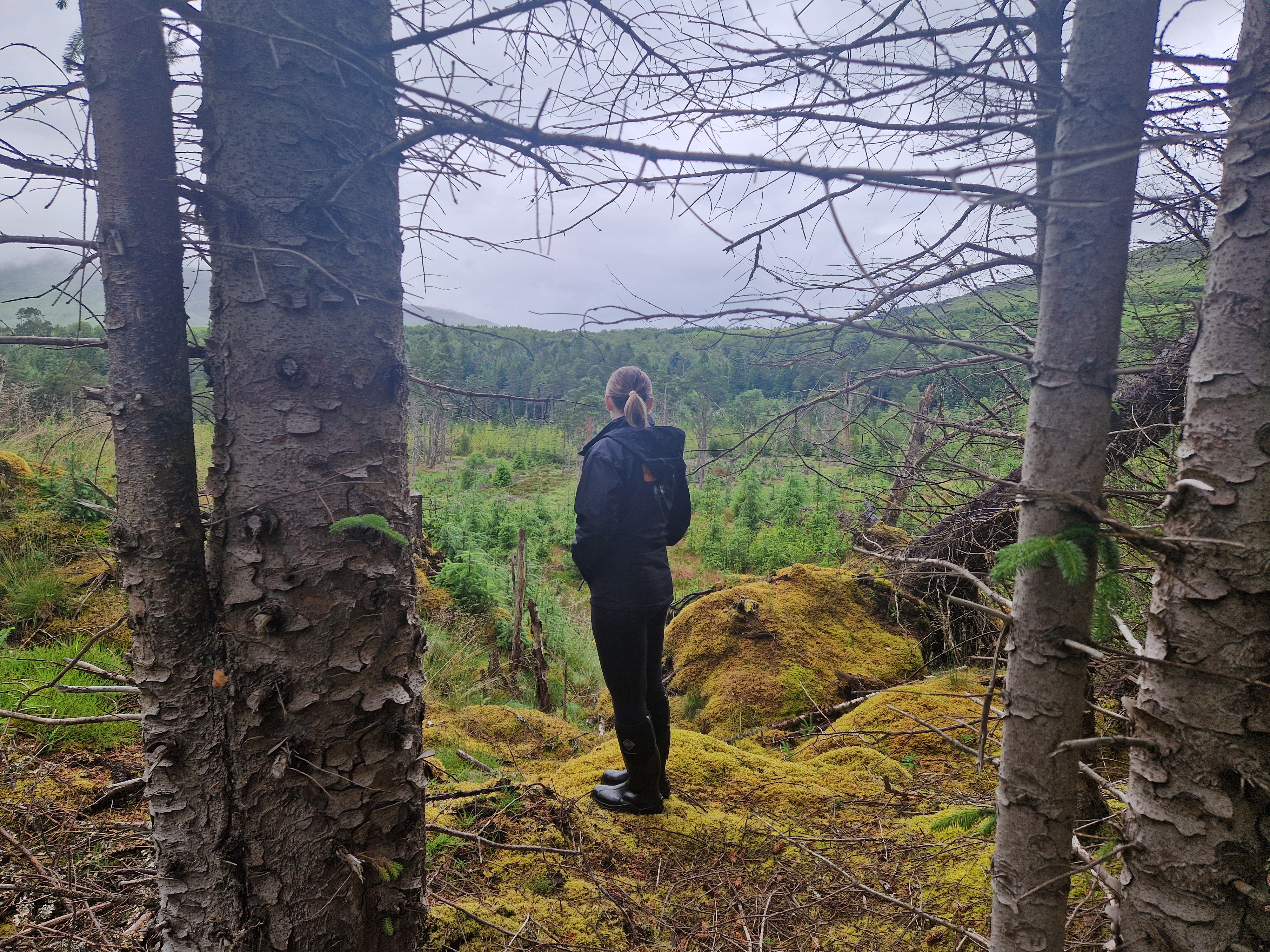
Spending the day with the Saving Wildcats field team
Since the initial release of 19 wildcats in the Cairngorms National Park (CNP) three years ago, Saving Wildcats has successfully introduced a total of 46 individuals to date. The field team have their work cut out for them, as they play a vital role in monitoring the wildcats after their release. To find out more about what this team gets up to on a daily basis, Saving Wildcats outreach and engagement volunteer, Morganne, joined field officer Lara for a day out in the field:
“At 9:00am the field team shelter from the Scottish rain in the Saving Wildcats’ offices at the Royal Zoological Society of Scotland’s (RZSS) Highland Wildlife Park. Five of us gather around the table to discuss what wildcats need to be tracked today. Lara and I have been assigned the task of tracking three wildcats, including the enigmatic Clootie, in the south of the project area. Wildcats are elusive creatures, so I prepare myself for the ultimate game of hide-and-seek.
As we prepare for the day ahead, Lara and I pack one of the Saving Wildcats’ trucks with bait to use on a camera trap, a Yagi antenna, a receiver, a base-station and connecting cables to track the wildcats and memory cards for camera traps. Lara explains that a Yagi antenna is a handheld directional antenna used to point us in the right direction of a wildcat. Additionally, the truck has an omnidirectional antenna attached to it, allowing for a continuous 360-degree search around the vehicle whilst on the road. The Yagi and omni antennas are attached to a base station and receiver. A simplified way of understanding the process is that the receiver gives us an audio cue, or ping, indicating how far we are from a wildcat. Once close enough to a collared wildcat, the base station connects to the collar, downloads the data from the GPS-radio collars and stores it until it can be uploaded to software back at the office. Once uploaded, the data then shows the GPS points on a map where the wildcat has travelled.
Lara goes on to explain that every wildcat has a unique GPS-radio collar with its own radio wave frequency, meaning that we can choose which wildcat to track. Using satellites, the wildcats’ GPS-radio collars collect spatial data. The team collects data from newly released cats every 30 minutes, whilst the data from wildcats released in previous years are collected every six hours as they are more likely to have an established territory that they are unlikely to move out of. Taking a fix less frequently also extends the battery life of the GPS-radio collar.
Our detective work begins as soon as the working day starts, at 10:00am, when one of the female wildcat's collar’s 'pinger' starts transmitting. Once the truck is packed, we hit the road searching for her. We visit an area where we know she holds a territory and drive down roads of every size in the hope of hearing the receiver make a ping noise. Minutes go by and still nothing.
Then, as we drive into an open area. “That’s her! The base-station has downloaded her data, so she must be close by.” says Lara. I think to myself “how does Lara know this? I didn’t hear anything”.
After spending four years tracking wildcats, Lara can hear the faintest ping from the receiver that my untrained ear misses. After jumping out of the truck, we used the Yagi antenna to determine from what direction her collar’s radio waves are coming from. I must admit that the antenna was a lot heavier to carry than I had anticipated and keeping a steady hand whilst holding it at head height is much harder than it looks.
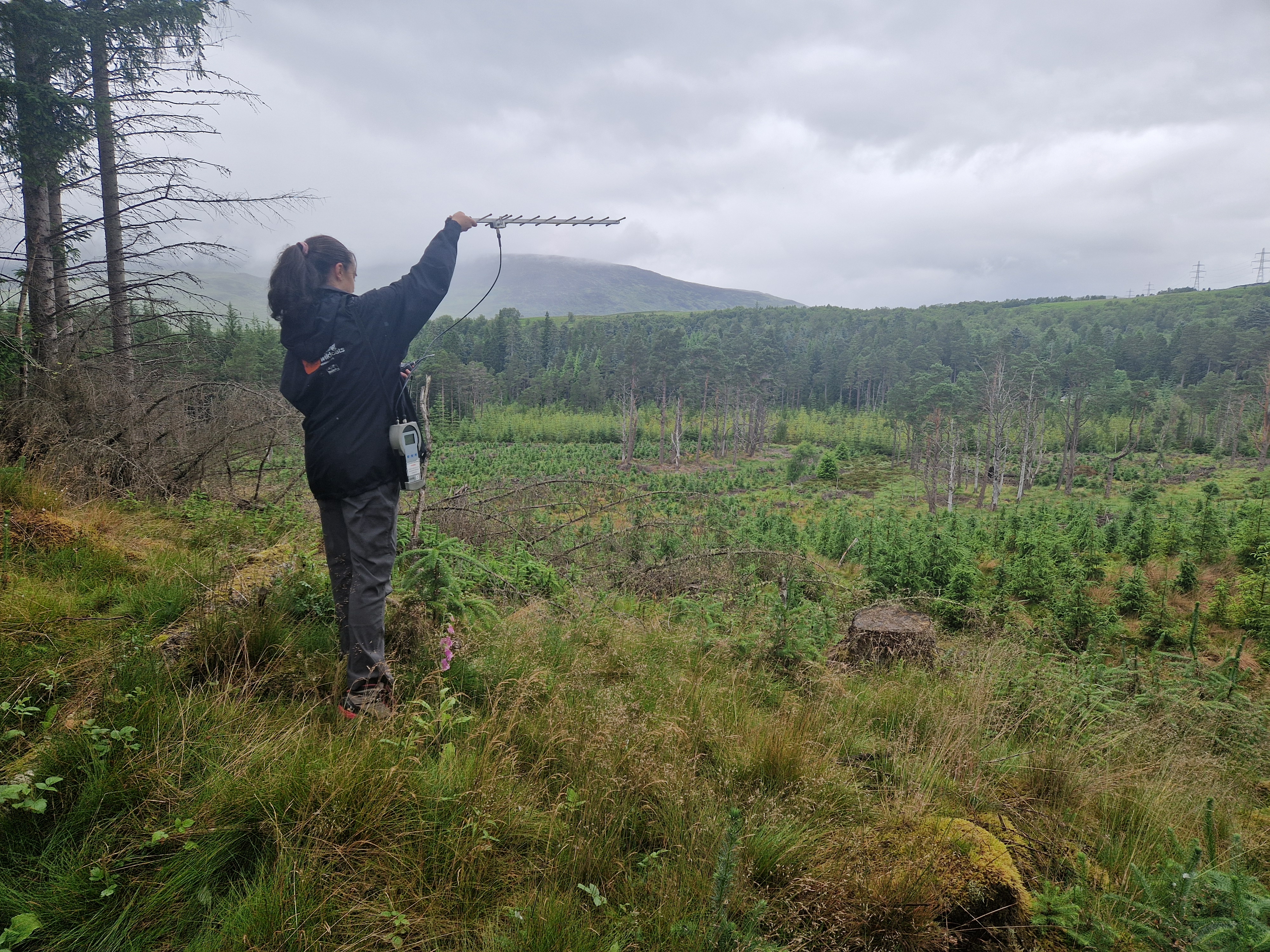
Outreach and engagement volunteer Morganne holding the Yagi antenna, searching for a wildcat.
Next on the list is a male wildcat. GPS-radio collar data has shown that his movement has decreased. To keep an eye on him, the team placed a camera trap baited with rats, in the hope of capturing a video of this elusive individual. Our goal today is to locate him, download his GPS-radio collar data, replace the camera trap’s SD memory card and rebait it with fresh food. After a short drive we enter his territory.
The area this male wildcat is occupying is similar to the territory of the female wildcat that we just tracked. It has varied vegetation and habitat types present as it covers a vast area. There is a mixture of old forest patches, cleared areas, and even an additional little stream. Wildcats like a complex mosaic of habitats as they provide a mixture of hunting grounds and areas for shelter. It doesn’t take long to find him. In a matter of minutes, we hear the much-anticipated ping as the receiver connects to the car’s antenna. Just like that, the male wildcat’s GPS data is downloaded!
First task complete, we now move to collecting camera trap data. We trek through rugged land and cross the small stream to get to a well-hidden camera trap. Even with my glasses on, I cannot spot it. As we approach the area, we look for signs of wildcat: paw prints, scat, hair. Nothing. But the rats that were placed in front of the camera trap are now gone. Images from the camera will hopefully tell us who took the rats – paws crossed it was the male wildcat!
We replace the memory card in the camera trap and place new rats in front of it. As we walk back to the truck, the rain strikes again, along with it... midges! We get in the truck, sheltering from the onslaught of biting insects, and look at the videos the camera trap captured on Lara’s laptop. It is safe to say that the male wildcat did in fact eat the rats and is not camera shy. It’s hoped with a little extra boost of food, this male’s movement will increase and he will go off adventuring again, deciding where to make his territory.
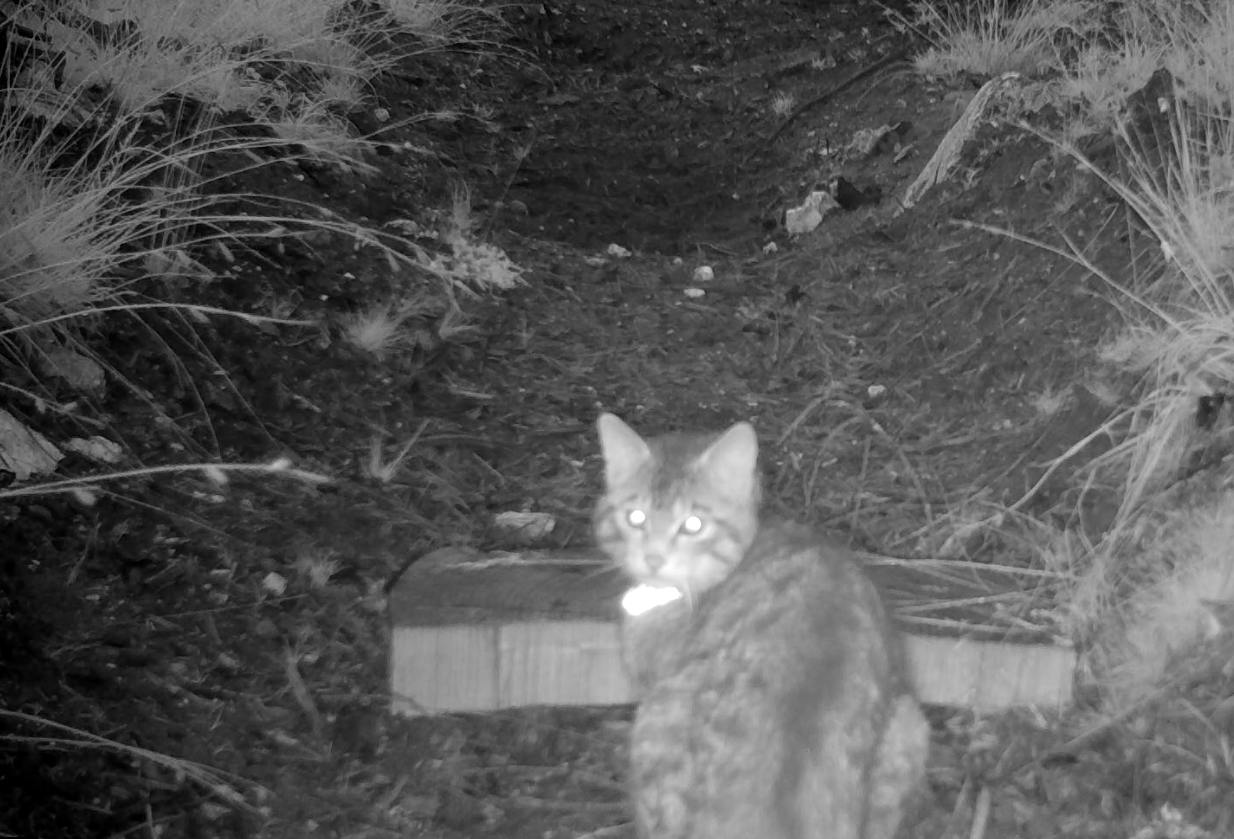
A male wildcat caught on a camera trap, hunched in front of rats.
With confirmation that the wildcat has eaten and is looking healthy, we move on to tracking the last wildcat of the day, a female named Clootie. She was released last year and we already know her established territory, making it easy to find her. Luckily, we are using a truck as Clootie’s territory is off-road and very bumpy. We arrive in her territory, but the truck's antenna is not picking up her signal. So, out we go with the Yagi antenna in hand. As we follow the pings of the receiver, we slowly but surely narrow down Clootie’s location. It is a lot of hard work, but we manage to get closer. Close enough, I’m sure, for Clootie to see us, but far enough away for us not to see her camouflaged in the bushes. It is fun and challenging to track down these wildcats in their homes!
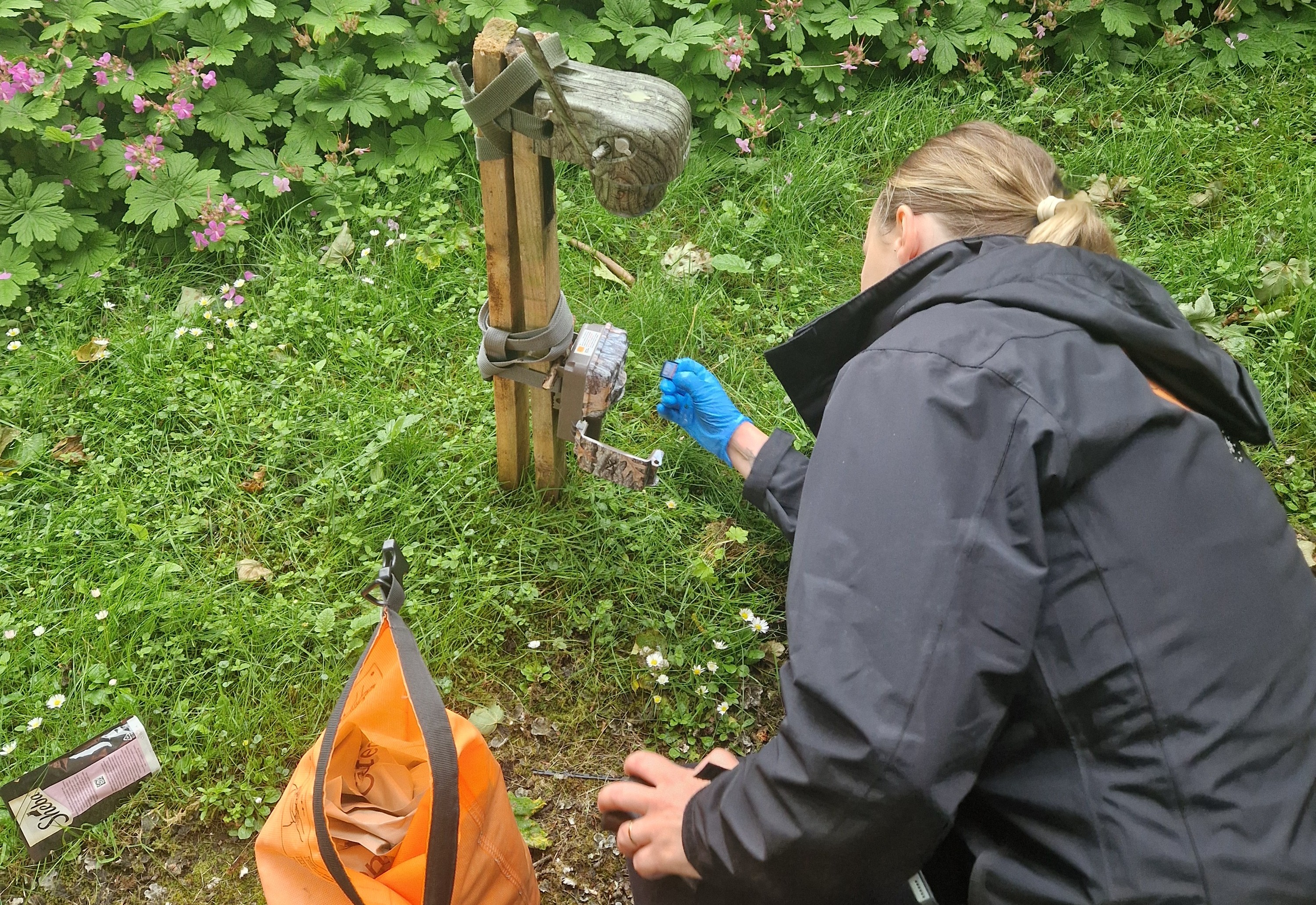
Saving Wildcats field officer Lara changing the SD memory card of a camera trap.
Now we’ve tracked Clootie, we go and check cameras in her territory to see if they’ve captured her with her new kittens!
After a short drive, we find the first camera trap. After a quick check, and replacement of the memory SD card, we jump back in the truck, knowing that today's field jobs are nearly done.
As we drive to the final camera trap of the day, I believe that we are truly lost. We have gone up, down and around many hills, but I trust that Lara knows where we're going – she has four years of experiencing tracking these cats, and an extensive knowledge of the local area. After a long period of driving, we finally pull up to a camera trap on the edge of a forest. For one last time, we grab the equipment from the truck and make our way to the camera trap. Next to the camera trap, there’s a wooden post on the ground that the team had placed upright the previous day to hopefully attract any wildcats that pass by.
A pouch containing valerian root has been attached to the post – wildcats are typically interested in this scent and will often rub on posts carrying the scent. They will typically spend enough time around the post to allow the camera trap to record them. Before heading back into the truck, we rest the post upright, reapply valerian root scent, and collect the SD memory card.
Back in the truck, we scroll through hundreds of images from the camera trap. A pine marten had a nosey yesterday afternoon, but sadly, no wildcat this time. However, we do see a ginger ‘Irn Bru’!
Don’t be alarmed, this isn’t a can of the beloved Scottish drink, but a feral domestic cat the team have nicknamed in the area. The camera trap footage shows him scratching and rubbing against the post. The team are closely monitoring him as he sometimes enters Clootie’s territory. A large part of Saving Wildcats project is a Trap, Neuter, Vaccinate and Release (TNVR) programme, run with support from partner Cats Protection, to help reduce the risk of interbreeding between wildcats and feral domestic cats.
Camera traps play a vital role, not only helping to track released wildcats, but also other cats, including potential feral domestic cats. The team can then follow up locally to confirm whether or not the cat has an owner, and whether it is indeed feral. Once this has been confirmed, the team can then begin the challenging task of trapping, neutering, vaccinating and returning it. This programme reduces the risk of disease transmission between wildcats and feral domestic cats and reduces the chances of feral domestic cats interbreeding with wildcats.
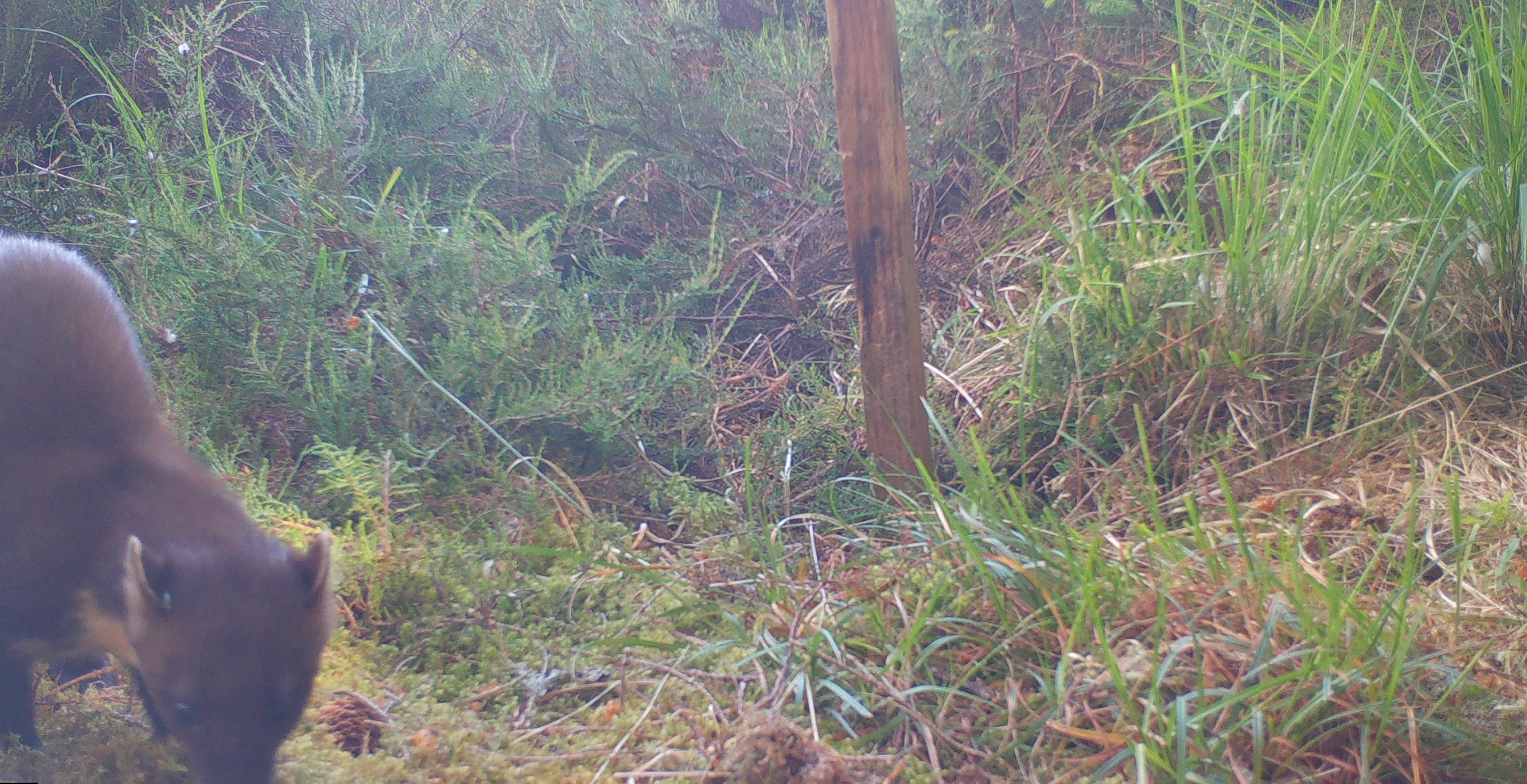
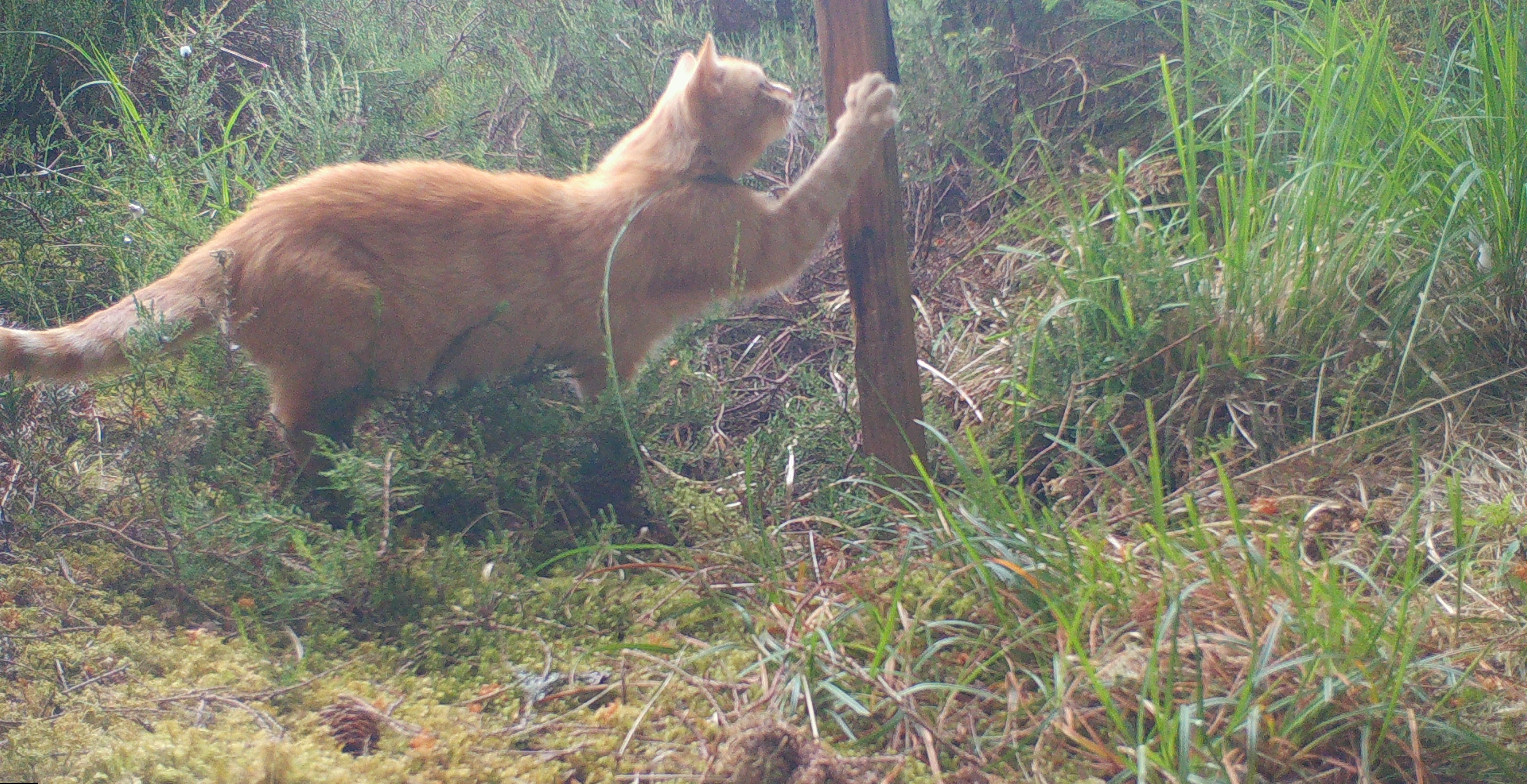
Photos taken by a camera trap. Top image: a pine marten passing in front of the camera trap, Bottom image: Irn Bru the feral domestic cat, scratching a post.
As the sun burns through the thick clouds, we end our day back where we started. Back at the office, we upload the data to software to analyse data from the GPS-radio collars, giving further information on their daily locations, speed of movement and angle of movement i.e. lateral, up-down and forwards-backwards movements. This can help us determine what sort of behaviours they are exhibiting at different times of the day. For example, a sharp increase in speed can indicate hunting behaviour. All this data is documented for future use in behaviour tracking and research.
Now that the day has come and gone quicker than you can say Felis silvestris, the scientific name for wildcat, Lara and I have successfully tracked all three wildcats, despite the midges and rough terrain. I am exhausted from such a full-on day, yet the field team will do it all over again tomorrow. The data that I have helped Lara obtain today is crucial to whoever is tracking the released wildcats next – each day builds upon the last, with the field team making informed decisions about how best to track each cat every day. The team are always on the hunt for these elusive creatures, with their determination, expertise and knowledge supporting the search for Scotland's wildcats."