
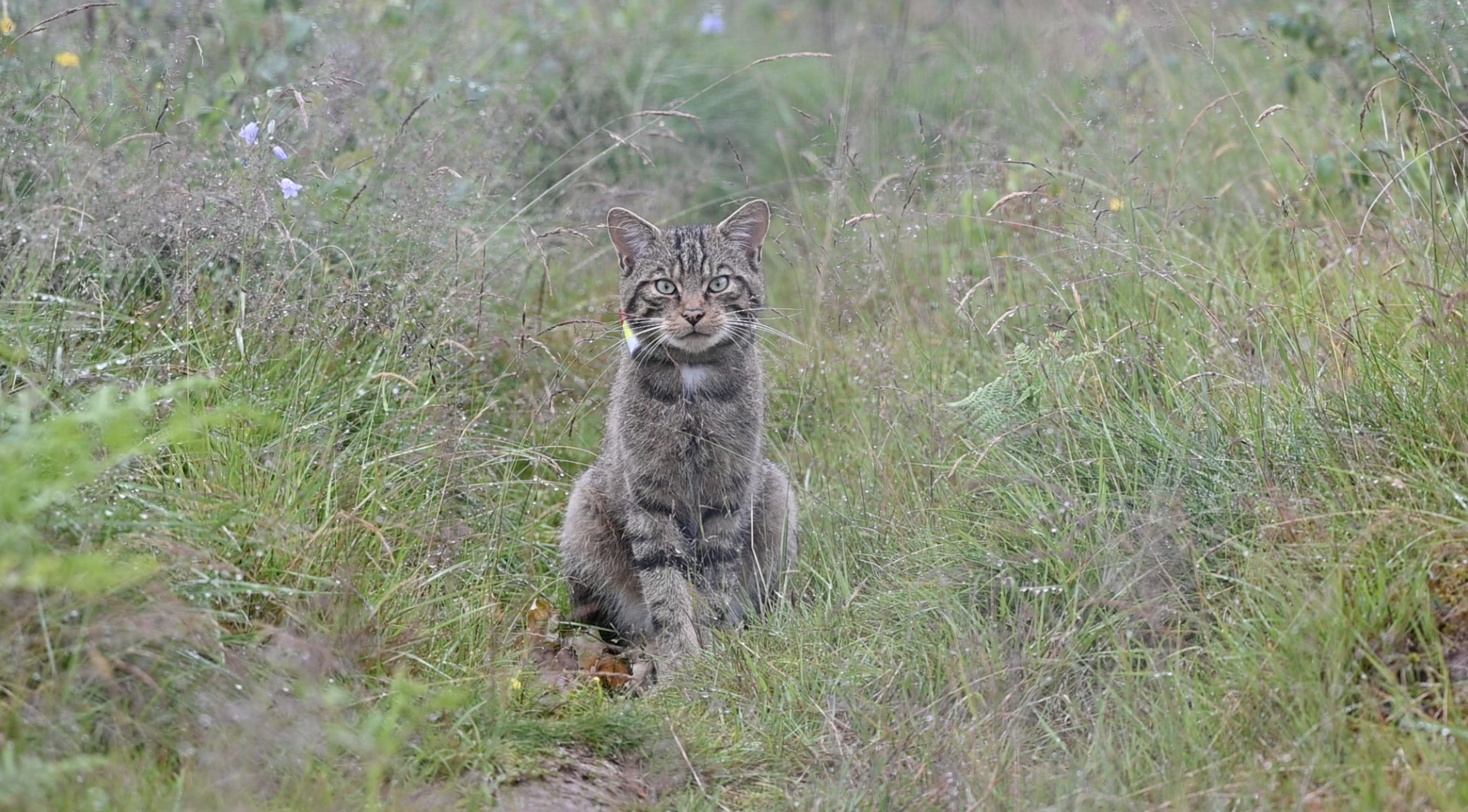
Our approach to understanding hybridisation
Despite being two species separated by approximately a million years of evolutionary history, wildcats (Felis silvestris) and domestic feral cats (Felis catus) can interbreed (or hybridise), producing fertile offspring. Genetic research shows that the impacts of hybridisation (interbreeding) between wildcats and domestic cats in Scotland have only occurred recently – in the last 70 years, despite native wildcats and non-native domestic cat being in contact for much longer than this in Scotland – potentially up to 2000 years. This recent increased rate of hybridisation is likely because of a drastic reduction in wildcat numbers because of historical habitat loss followed by persecution. Both the small numbers of wildcats present in the landscape and the fragmentation of the population (how spread out the population is) have likely increased the risk of hybridisation with domestic cats – essentially the few remaining wildcats have little choice other than to mate with domestic cats. A comprehensive overview of the risk of hybridisation to Scotland’s wildcat population can be found on NatureScot's Genetic Scorecard Indicator.
Since hybridisation is more likely to occur when the number of wildcats is low, any further releases of wildcats into the same area could not only help to boost the wildcat population but also help to limit the proportion of hybridisation events that occur in a population.
This underpins the approach of Saving Wildcats – which aims to prevent the extinction of wildcats in Scotland by breeding them for release into the wild. The partnership has now released 46 wildcats into the Cairngorms National Park over the last three years.
Following the first releases of wildcats into the Cairngorms Connect landscape in 2023, using a combination of data from GPS-radio collars and camera-trap footage, seven females were found to have given birth to kittens during the summer of 2024. This was a significant milestone – released animals do not always successfully produce offspring in their first breeding season in the wild because of the challenges involved with adapting to their new environment, finding food, shelter and mates.
Following the birth of these kittens, the Saving Wildcats team tried to find out more about the paternal origin of each litter (if the father is a wildcat). There is always a risk that a female wildcats’ kittens could be fathered by an unneutered domestic feral or pet male cat, as well as the risk that male wildcats could impregnate a domestic pet or feral female cat.
Using location data obtained from the GPS-radio collars that the wildcats were fitted with prior to release, the team thought it was likely that five of seven females that gave birth to kittens in 2023 could have bred with one of the released male wildcats.
Genetic testing was subsequently used to learn more about the provenance of some of these litters. This process is time consuming, taking several months from the point of identifying kittens in the wild to obtaining a genetic result in the lab.
To obtain a genetic sample to conduct testing on, the team carefully monitored the released females and their offspring using trail cameras and where appropriate, placed an un-set humane and cat-specific trap deployed with permission from the landowner in their close vicinity. The traps were baited with food and scent lures (strong smells that wildcats like) to attract the cats into the traps.
Over the next few weeks, the team monitored the kittens closely as they became comfortable with the traps, before finally setting them during a suitable weather window. Once the kittens had been caught, a hair sample was then taken and sent to the Royal Zoological Society of Scotland’s WildGenes laboratory for DNA extraction and analysis. Wildcats are a protected species and the process of sampling the kittens was done under licence issued by NatureScot. Following an intensive amount of work, the team were able to trap three kittens from one litter and one kitten from another. A further genetic sample was obtained from a young kitten from an additional third litter that was assumed to have died as a result of a road traffic accident.
Genetic testing has now made it possible to reveal the paternity of kittens from three of the seven litters. The results confirm that two of the released females did indeed breed with one of the released male wildcats as suspected. The results also confirm that another female, whose GPS data showed that she had not been near one of the released male wildcats, interbred with a hybrid (an individual with a mixture of wildcat and domestic cat genes). Some of her offspring were subsequently neutered to prevent further hybridisation within the wild-living cat population.
There was no released wildcat male in the vicinity of this female. Although the best efforts of the Saving Wildcats team and the local Strathspey branch of Cats Protection to trap, neuter, vaccinate and release feral domestic cats and hybrids in the local area (an internationally accepted method of feral cat population control, which is a safe and non-lethal), the risk of interbreeding between wildcats and domestic cats is very difficult to completely remove.
The wildcat population continues to be monitored including through the genetic testing of kittens wherever feasible and hybrid animals are neutered following NatureScot guidelines. The project continues to work closely with Cats Protection on TNVR and responsible cat ownership messaging locally and shares its result to support policy change.
This discovery highlights the critical contribution to wildcat conservation that local people are making by ensuring their pet cats are neutered, as well as microchipped and vaccinated. Ongoing monitoring of the wildcat population as it becomes established is critical so that we can gain a full understanding of the risks it faces and target conservation action appropriately.