
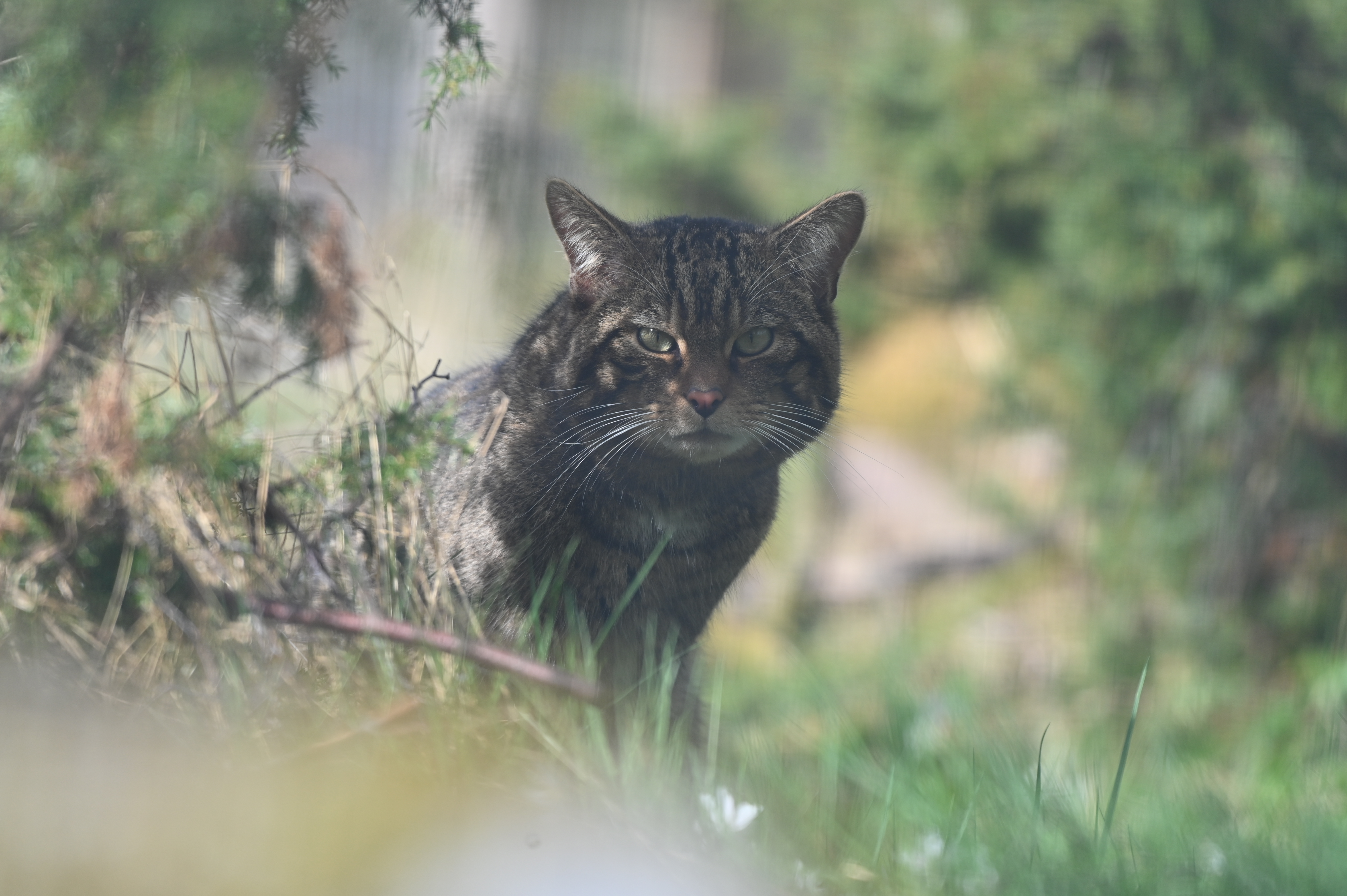
First year of wildcat reintroduction project hailed as big success
Original press release on NatureScot's website.
New research confirms that the first year of a project to reintroduce wildcats to Scotland was highly effective, with survival and reproduction rates exceeding expectations.
The study, published in a special edition of IUCN’s Cat News, concludes that breeding for release is an effective strategy for wildcat conservation, with 95 percent of released cats surviving their first ten months in the wild.
Approved under licence from NatureScot, and led by the Royal Zoological Society of Scotland, the Saving Wildcats partnership carefully selected a number of wildcats to be bred and prepared for life in the wild at a specialist breeding-for-release-centre at Highland Wildlife Park, before releasing 19 individuals into the Cairngorms National Park in the summer of 2023. Those animals were initially all tracked using GPS radio collars.
The cats surpassed expectations, with all but one surviving the first ten months in the wild. Health checks post-release showed very few signs of injury or disease, and the cats put on an average increase of 20% in bodyweight during the monitoring period.
However, the research also confirmed that hybridisation, through interbreeding with domestic cats, remains a threat to the long-term future of the species. To tackle this, Saving Wildcats has been working in partnership with Cats Protection to trap, neuter, vaccinate and return 132 feral domestic cats since the project began.
In 2019 wildcats had been described as at the brink of extinction in Britain, with the population too small, too hybridised and too fragmented to be viable. However, since then, 46 wildcats have been released through the Saving Wildcats project, with females in the wild successfully producing litters of kittens in 2024 and 2025.
NatureScot’s Species Project Manager and co-author of the study, Dr Martin Gaywood said:
“We’ve made huge strides for wildcat conservation in Scotland, and we now have the science and evidence to back up our theory that wildcats can be restored through careful planning, breeding and release.
“To see wildcats surviving so well in the wild and reproducing successfully is incredibly rewarding for everyone involved, including our many supporters and volunteers, and completely exceeded our expectations for the first year of the project.
“The road ahead is still uncertain, and challenges remain with issues such as predation on gamebirds and the threat of hybridisation with domestic cats, but we remain dedicated to the long-term recovery of this culturally and ecologically significant species. We will continue working with partners and local communities to secure the future of the wildcat in Scotland.”
Dr Helen Senn, Saving Wildcats project lead at RZSS, said:
“The Saving Wildcats project has been truly ground breaking, being the first in the UK to reintroduce a cat species. As such, we’re constantly gathering data to better understand the effectiveness of our work and use that information to make the process even better for wildcats in future. We’re now at the end of the third year of releases, but studies like this really help to illuminate just how big the challenge was in year one and how successful the project has been so far - against all odds. To ensure the survival of this species, it is vital that we continue further releases alongside managing the threats facing these amazing animals.”
Saving Wildcats is a partnership project led by RZSS in collaboration with NatureScot, Forestry and Land Scotland, Cairngorms National Park Authority, Nordens Ark and Junta de Andalucía. Releases are being conducted with the support of Cairngorms Connect and Trap-Neuter-Vaccinate-Return work to mitigate hybridisation (interbreeding) is conducted together with Cats Protection.